Uncle Tim's eGuitarCenter - Technical Training For Guitar

If you want to play scales, videos will make it very clear

Video Open String Scale Series

Little StretchThe first multimedia tool of this strategy is the video series. With these videos you can watch me play each open string scale presented in Uncle Tim's First Year. This is important because when you see it, you can easily learn why the finger strategies are so important.

You can see the tiny nuances of changing strings. Every string is a little different than the others and there are many different ways of moving across them . Videos reveal all the small undocumented moves.

When people learn to play they often try to learn by playing chords. The emphasis is on holding down the chords properly. While this is very important it does not address a much bigger concern.

Playing guitar is as much about moving to a new position as holding down a chord. Your fingers in motion are a far greater concern because there is more that can go wrong.

If you are focusing on a static hand position, it does not address the mechanics of movement, and that hidden concept is quite important. Playing guitar is all about movement and the video series captures this.

No longer do you have to worry that you are playing the scale incorrectly or missing notes. You can see it and hear it in real time. Yo can see my exact hand position and understand how little hand movement is actually necessary. At first your hand may flail all over the fretboard, but with time you can easily learn to control your movements. Video scales remove all the questions and allow you to just focus on hand position, movement and sound. And every movement will be carefully explained as you will see below.


Here is the C major scale

I strongly suggest you read the information in Uncle Tim's First Year about technique and hand position before you begin this scale. There is much that happens behind the scenes and reading about it can make a big difference in how you approach this and all other scales.

The video on playing the open string, first position C major scale will start automatically once it is finished downloading. Remember this all applies to the A minor, open position scale as well, since it is the exact same pattern of notes.

C Major Video Scales

Getting started with the C Major scale.

guitar music theory books, guitar lessons, lessons, guitar, chods, scales, diatonic, pentatonic, whole tone, diminished, blues, flat 3rd scales, exercises, chord exercises, scale exercises, music theory, guitar music theory, learn to play guitar, music lessons, pentatonic guitar scale modes, musical keys, fretboard, fingerboard, guitar theory, uncle tim's first year, pentatonic scales, online guitar chords, guitar music theory books

The first thing to remember is the finger assignments. The index finger hits all the notes on the first fret. The second finger hits all the notes on the second fret. The third or ring finger hits all the notes on the third fret. The pinkie finger hits all the notes on the fourth fret. In this scale the pinkie is not invoiced because there are no notes to hit on the fourth fret. The pinkie will be used in the very next scale, so it makes sense to talk about it now.

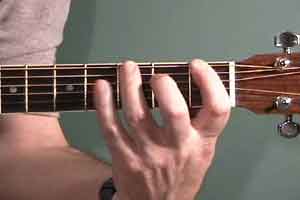
The F note. Play the F note with your index finger. Notice how the rest of the hand is directly over the frets too. They are so close to the notes they need to cover that it will be easy to quickly move them into the exact position they need to be in. Looking at this picture below, it can be hard to see exactly what note I am hitting, however, this is exactly the way it looks when I play the scale. In fact this picture was taken from a video clip of me playing the scale, so this really is what it looks like.

A beginner may have trouble duplicating this move exactly, however, your hand will eventually discard all the wasted motion and do this (with time).

My hand is ready to move to the next note, the G note on the low E string.


The G note. Notice the movement to hit the G note right after the F note is very slight. This is a result of the finger assignments. With practice your fingers will be able to maintain these regimented finger assignments with very little additional movement. Also notice if I want to go back and hit the F note, I can easily do this.

These finger assignments work very well with compressed scale passages because all the notes are so close together. It is not the only finger assignments we will use, but these are widely used for all sorts of scales.


The A and B notes on the A string. The A open string note is not shown because the fretboard hand has no assignment but to get out of the way. All you have to do is make sure you are not muting the string as you play the open A note.

The B note. The B note is on the second fret so the second finger is used to play it. When I look at this picture I find it hard to tell if I am playing the B note or the C note right under it. This is deliberate because I am actually getting ready to play the C note next. I can easily left my finger from the B note and play the C note right away. With time this will become automatic.


guitar music theory books, guitar lessons, lessons, guitar, chods, scales, diatonic, pentatonic, whole tone, diminished, blues, flat 3rd scales, exercises, chord exercises, scale exercises, music theory, guitar music theory, learn to play guitar, music lessons, pentatonic guitar scale modes, musical keys, fretboard, fingerboard, guitar theory, uncle tim's first year, pentatonic scales, online guitar chords, guitar music theory books


The C note. All I did was lift up my second finger and pre3ss down with my ring finger. Simple and extremely quick. I want to caution you to practice this stuff slowly because you will learn it much better and you will not make as many mistakes when you try to speed it up.

My fingers only move slightly. There is not much motion going from one note to the other. This minimizes the distances you need to cover as well as the possibilities for making mistakes.


The open string D note.

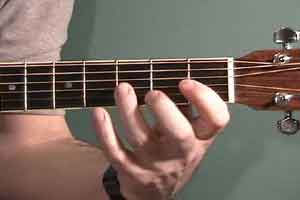
This picture is blurry because I am hitting the open string D note as I prepare to move to the next note, the E note on the D string. I included it to illustrate how it happens in sequence. It is part of the overall motion of playing this scale and drilled in my hands by hours and years of practice. My muscles have developed serious memory and can easily switch notes because they are well practiced at it.


guitar music theory books, guitar lessons, lessons, guitar, chods, scales, diatonic, pentatonic, whole tone, diminished, blues, flat 3rd scales, exercises, chord exercises, scale exercises, music theory, guitar music theory, learn to play guitar, music lessons, pentatonic guitar scale modes, musical keys, fretboard, fingerboard, guitar theory, uncle tim's first year, pentatonic scales, online guitar chords, guitar music theory booksThe E note on the D string. Now I am hitting the E note using my second finger. The motion is quite small and exact. Motion and energy is conserved. I only need to hold down this one note and get ready to play the F note. Once again this will be more difficult at first, but it will become much easier after you have played this scale for a month or so. It will continue to get easier over the next few years as your body learns to do only what is necessary. Conserving motion is the key.


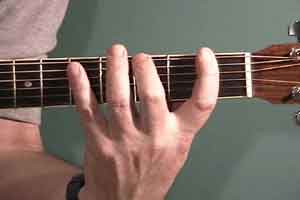
The F note on the D string. IT can be hard to see any difference so I put in a photo with some motion to show you the second finger is lifting off the E note and the third finger is now pressing down on the F note.

Make sure you notice how close to the fret my finger is. By pressing down close to the back of the fret, you minimize the chances of making the string buzz because of vibration and improper finger placement. In some of these picture it is hard to believe I actually place my finger behind the fret because it looks like I am on top of the fret. But this is actually what it looks like. Rest assured, I am getting close to the fret but pressing the string down behind the fret.


The open string G note is played with my fingers off the fretboard.

The A note (below) is played by pressing down with my second finger. This is the only note on the G string so my other fingers are preparing to leave this string and move to the B string.

At this place I noticed that it can be hard to move to the C note on the B string because you have to move your entire hand including your palm. This is accomplished by moving your thumb ever so slightly or increasing your stretch.

Notice you do not see my thumb at all. Occasionally it will slip up high enough to become visible, but for the most part it is right behind the second finger and riding the ridge of the back of the fretboard.


The B note is played open and not shown. The C note is played with the index finger and you can see my thumb has moved slightly during the process. It is slightly visible.

This slight adjustment may be necessary to keep from hitting the string incorrectly. If you do that the note will not ring out. I advise you to look closely at the video and notice the slight adjustments of hand position as this note is being played. I consider this one of the hardest notes in this scale, but not very difficult once you get the hand of playing it.


The D note is next. There is a little cheating occurring with this note. I am actually stepping on the G note on the high E string, however that note is not played yet anyway, so muting it is not really a concern. This way I do not have to come down directly on top of the note.

Be aware there will be times when you must hit this note without interfering with any other notes. This happens when other notes are ringing out and you need to play this note without muting any of the other notes. With some practice this too will become automatic.


The E note is next and not shown because it is an open string note. You do not press the E string down for this note.

The F note. Okay now there are some new dynamics to discuss as we incorporate this note.

You can still see my thumb in the background. My palm (not clear) is also quite far away from the fretboard. If my palm is smashed up against the fretboard this note may not come off cleanly. It may be muted. Also moving to the next note, the G note two frets higher, will be compromised. So by keeping your thumb from sliding up and wrapping the fretboard, you increase the chances you will hit the G note without muting it. Anybody that wraps their thumb and tries to do this next move will face a limitation due to the technique of wrapping their thumb. By keeping your thumb in the right position you can easily hit the G note without causing additional adjustments.


The G note. This is the last note in this ascending scale. playing the scale passage in a descending order will be very similar to these motions. You can clearly see in this picture that my palm is far away from the fretboard which allows me to have room to maneuver.

You can see it looks like I am pressing down on the fret, but I am actually pressing the string very close to the fret. Believe it or not, this note came off cleanly. When you first start to play this scale, make sure you are hitting the string right behind the fret, not on top of it.

Also notice that if I am going to descend down the exact same scale I just played, I am ready to do so. In fact my index finger is very close or still hitting the F note.


That is all there is to this scale. There are a lot of micro motions your fingers will learn as you practice this scale. In my opinion, the next scale the G scale is a little easier to play because instead of hitting the F notes, you use the F# notes. This makes it a little more comfortable to play. Make sure you master this scale.